Pages

Thursday, February 17, 2011

Collaborator - Double Decoction Doppelbock

Mmmm, Celebrator.
THE PLAN:
My friend and brewing co-hort Matt and I have many things in common, but one of them is that we are suckers for Bavarian Doppelbocks. We have been talking about doing a batch of beer together, and simultaneously, we have been talking about experimenting with a historical brewing style called decoction. Doppelbock happens to be one of those styles that was traditionally a decoction mash, so we decided to not only do a decoction mash for a batch of doppelbock, but we would do two mashes, one as a double decoction and one as a single infusion batch sparge. The main idea is to brew both identically in every way except the mash styles, and then compare the final results.


THE RECIPE: (this is for a 3 gallon batch, we'll be using this for each), basically taken from Brewing Classic Styles.
7# Munich
2# German Pils
1# CaraMunich III
3/4 oz Hallertau (60)
1/4 oz Hallertau (30)
2 Activator packs of Wyeast Hella Bock 2487, 2L starter on stir plate, stepped up to 1gal, refridgerated and decanted.  Had about 1&1/2 cups of yeast for each 3 gallon batch.

2/13 BREWDAY:
What a freakin day it was.  The infusion mash went smooth, the decoction mash... not so much, but they both ended up fine.

Infusion Mash
Decided, after much debate, to do a single infusion mash rather than a double infusion for sake of time and effort.  12.5 qts to 10# grain, strike @ 155 for 60 minutes.  After an hour, we only lost about 2 degrees.  Collected ~3.5 gallons first runnings @ 16 Brix/1.065, collected another gallon or so at 9 Brix/1.036.  Total pre-boil volume was about 5 gallons (1/2 gallon more than what we were shooting for) and our pre-boil gravity was 13.8/1.056.  We boiled down to 4 gallons, then threw in our first hop addition and proceeded through to knock out.  Chilled down to 48F, pitched the yeast, and let sit outside for about a 1/2 hour to chill down a little more.  Only went down about 2 degrees.  It's now sitting on the floor of my basement (ambient temp is 53F +/-) and seems pretty steady at 52F.  2.75 total gallons, OG Brix 19.4/ hydrometer 1.084.  Doughed in at 11AM, pitched yeast at 5PM.

Decoction Mash
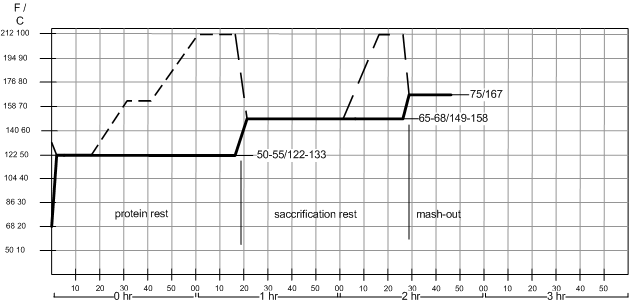
Good gravy, this was labor intensive and not completely rewarding, but we managed to get through it, and it was a great learning experience.  We planned out a double decoction, and the basic gist is to put all of your grain and all of your water (minus sparge water) in at a low temp, take out a 1/3, raise it to a sacch rest, then raise to boiling, then repitch into the whole batch raising it's complete temp up to a sacch rest.  That's one step.  You then take another 1/3 out after the rest is completed,  raise it to a higher sacch rest, then to boil, then repitch raising the whole batch to a mashout temp.  Sounds easy, right?!  Well, we got 2 out of 3 right.  When decocting, you typically (depending on who you talk to) use a thinner water:grain ratio, like 2:1 rather than 1.25:1.  We doughed in with 20qts water @ 122 for our first rest.  After some time we were ready to take out the first 1/3.  We ran into our first problem here... how do we determine how much to take out AND do we strain the grain or take out the whole mash?  There was a BrewStrong podcast about decoction, hosted by Jamil, John Palmer, and Denny Conn... and they said you strain it and just heat the grain.  We had also read and talked to some people that said you take everything.  We kind of went middle of the road and took the grain plus some of the mash water.  But, apparently we didn't take enough because when we pitched it back in, it only rose about 15 degrees, where we needed 30 more.  Before that though, during out first decoction step, we learned how labor intensive decocting really is.  You have to stir continuously, and that shit was thick.  The temps were all over the damn place, and when we finally hit out sacch rest temp, it didn't stay there long unfortunately.  We finally got it up to boiling, and like I said earlier, when we pitched the boiling heap back in, the mash temp in the cooler was at 116 and only rose to about 130, we needed to raise to 149 or so.  We pulled out a bunch right away and started heating our second decoction step, same as the first - 158 then boiling.  If this was done correctly, then the mash in the cooler should have been resting the whole time at 149, instead it was sitting at 130.  Not much we could do, so we continued and tried to get this one (a much bigger chunk of the mash) up to temp and pitched back in.  It still took a long while, can't recall exactly how much longer, but we finally got it up to temp, pitched it back in and still fell a little short, so we added a few quarts of boiling water and had the whole heap up at 160-ish.  Our first collection was roughly 3.5 gallons @ 14.8 Brix/1.060.  We ran a small sparge amount through and collected another 2 gallons when it was all said and done, second runnings were 10.2/1.041.  Total pre-boil volume was 5 gallons and pre-boil gravity was 13.4/1.054.  2 points lower than our infusion mash.  We followed the same boil & hop schedule as the infusion mash, throwing in first addition at 60 minutes left (when it hit 4 gallons), and then 2nd addition at 30 minutes left.  Ended up collecting between 2.5 & 2.75 gallons, chilled down to about 49/50, pitched the yeast, set outside for about 15 minutes, then down to the basement.  Last I checked it was sitting pretty at 52F.  Close to 2.75 total gallons, OG Brix 22/1.092 (a bit of a surprise).  My hydrometer broke, so I had to rely on my refractometer for the reading, but should be about right, and I ended up checking three different times throughout the collection to make sure it was right.  Time: doughed in about 11:30/11:45, pitched yeast at 8:30PM. 

Brewday thoughts:
What a long day, we started milling grains and measuring/heating water at 9:30 AM, and I pitched the 2nd yeast at 8:30PM and still had an hour or more of clean up to do.  So easily 12 hours.  Matt projected a 10 hour day, and I was like "no waaaayyyyy, we got this in 6 or 8 easy!"  Errrr, big swing and a miss, B.  There are a lot of numbers up there in those two mash schedules, but not much description of what was going on.  The infusion mash seemed like any other mash, sweet, bready malt aromas and typically colors.  The decoction was pretty interesting to watch, smell, and taste.  The wort got really dark and cloudy.  Lots of caramel aromas, chocolate, etc.  It looked & felt thick, even though it was a 2:1 ratio.  The starting gravities were about 10 points different which is a little disappointing, but that's fine.  Our biggest frustration was how to figure out what exactly 1/3 of the total mash looks like, and in turn not hitting getting our first step to raise the overall temp up to where we needed it to be.  I think if we could figure that out, I'd be interested in doing this style again... I think.  We may be perfectly happy with the results we get with the simple single infusion batch sparge method too that took 4 hours less time.  If the decoction produces a far superior beer (which I'm doubting), then I would probably opt to do it for the styles that lend themselves to it - bocks, hefs, etc.  We shall see!  But honestly, I'm thinking about what to do next with this style. 

2/21 CHECK-IN:
Activity has slowed way down, but still some churning going on.  Temps are about 50.  I took a small sample of each out this morning to test gravity.  My hydrometer broke during the last brew, so this is just a refractometer reading that's been adjusted using one of these worksheets I have. 

Infusion - Brix 13.6 = 1.039
Decoction - Brix 13.6 = 1.032

I retested them twice since I got the same reading for both, which is pretty crazy.  The infusion one smelled great, just like Celebrator.  The decoction one really didn't.  I have a bit of a cold still so my smells are a bit off anyways, so I wouldn't put too much stock in my sense of smell right now. 

3/27 RACK TO KEG (LAGERING)
Many moons passed due, I finally got around to racking these two to kegs in order to lager them a bit.  I pulled a few samples for hydrometer readings, and for some taste evaluation as well.  The infusion one was fairly nice - clear, dark ruby, smelled and tasted to style.  The decoction... not so much.  Not sure how to describe it, but it didn't taste great.  It was much hazier too... and there was a lot of junk floating around in there too... grain & hop trub, proteins, etc.  Gravities of each were kind of surprising:  Decoction = 1.020;  Infusion = 1.031.  The decoction's was right one (even though it tasted awful), but the infusion batch's (which looked, smelled, and tasted great), was pretty high.  It should be around 1.025 or 1.020.  Matt and I will have to put our heads together and think about this a bit.

More later...

Saturday, January 22, 2011

Bourbon "Barrel" Imperial Stout

THE PLAN:
Last summer, I had the pleasure of visiting Minnesota. One of the great places I visited was the Happy Gnome, a cool little pub in St. Paul. While I was there, I asked for a glass of an imperial stout they had on the menu from Goose Island called Bourbon County Stout. When I said to the bartender "I'll try the BCS" he said "yes you will..." Holy mole, it knocked my socks off. Since then I've tried as many bourbon stouts and baltic porters that I can, and I am now taking a stab at my own creation.

Since I'm only brewing 5 or 6 gallons at a time, and actual wine or bourbon barrels are typically 59 gallons... I'm using oak spirals and will be soaking them in bourbon first, then adding to the secondary fermenter for 100 days.

The result will be a 13% monster.  Expected to be ready early summer, which isn't the greatest of times for an imperial stout... I'd rather be enjoying it in the fall or even dead of winter, but that's how it worked out, so whatever. This will be one that will be even better at this time next year!

THE RECIPE:
22# Pale Malt
4# Munich
1# Crystal 60L
1/2# Chocolate Malt
1/2# Roasted Barley
1/2# Black Patent Malt
8 oz Willamette
2 oz oak spirals
16 oz bourbon (tbd)
Yeast cake from oatmeal brown ale (wyeast 1028)

1/30? BREWDAY:
Hoping to get this brewed before the end of the month!

Monday, January 17, 2011

Patersbier

THE PLAN:
3 samples from brew day:
first runnings (left), second runnings,
and pre-boil (front)
Last summer I learned about a type of Belgian beer called Patersbier, brewed by monks, that never makes it to the public.  When I think of Trappist beers, I think of styles like tripels, dubbels, and strongs - both dark and gold.  Apparently the monks would make a "father's beer" that was like a tripel, just low in alcohol, usually around 4%, and keep it to themselves.  It sounded interesting, so I did as much digging as I could find, and put together a pretty easy recipe.  Goal is to have an easy drinking table beer, clean, clear, and still have that belgian quality to it.

RECIPE:
9# Pils (Franco-Belg)
1 oz Hallertau (60)
1/2 oz Goldings (10)
Irish Moss (10)
Wyeast 1214

1/17 BREWDAY:
Single infusion 90 minute mash w/ mashout & batch sparge.
Target temp: 148F
Target pre-boil gravity: 1.035
Target strike water: 11.25 qts @ 168 (5 degrees for cooler absorption, 15 degrees for grain absorption)
Target mashout water: 9.4 qts @ 200 (target temp = 168=170)
Target sparge water: ~2-2.5 gallons @ 168-170
-----------------------------------------------
Strike: 11.25 qts @ 168, 163 after added to cooler (preheated), 147-150 after dough in, avg = 148
At this point, the mash went longer because we had left and came back, temp down to 142/143F.
Mashout: 10 qts @ 200, added to mash, overall temp now 165-168... avg 165/166.
First runnings: collected 4.25 gallons @ 13.4 (Brix)/1.054
Sparge: added 2 gallons @ 186, added to grains, overall temp now 165/166 - still short of 168/170 target.
Second runnings: collected 2 gallons @ 6.75 (Brix)/1.027
Pre-boil totals: 6 gallons @ 11(Brix)/1.044
-------------------------------------------
Boil for 60 minutes, additions are Hallertau @ 60 minutes, Goldings @ 10 minutes
------------------------------------------
Chilled to 64 degrees, pitched Activator pack of 1214
SG: 5 gallons @ 13(Brix)/1.052

More later!

NOTES:
1/17 - This is a very simple, straightforward recipe, with the yeast being the star of the show.  I'd like to brew this again... even at this early stage, and split it up and ferment with different strains of belgian yeasts.
1/17 - Eventhough the single malt grain bill was simple to put together, I put much thought into the hops.  I norrowed it down to three: goldings, hallertau, and saaz.  I definitely did not want this smelling or tasting anything like a pilsner, and I happened to have both an ounce of hallertau and a 1/2 ounce of goldings, so that's what I used!

And a review from Mr. Don Osborn


Friday, January 7, 2011

Oatmeal Brown Ale

The Plan:
When I was visiting Minneapolis in June this past summer, I snagged a can of Surly Bender and Coffee Bender to bring back to VT.  It wasn't until November that I opened the Bender at a beer tasting.  I honestly didn't even look to see what the style was.  I think I must have looked at some point, but was pleasantly surprised to find out that it was an oatmeal brown ale.  It... was... amazing.  The aroma alone was enough to make my eyes roll into my head.  Extremely tasty.  Since I don't have access to it, I am going to try to make something similar.  This my take the place of the Third Stone Brown I do each year, which is a clone of Empyrean Ales' beer.

THE RECIPE:
SG: 1.057
FG: 1.014
ABV: 5.24%
IBU: 56.3 (this is a little higher than what they say on the surly website, but I'm ok with that)
srm: 22.6
---
7# pale malt
1# aromatic
2# flaked oats - kind of high on the oats, but whatever :-\
3/4# crystal 60L
3/4# crystal 90L
1/2# chocolate
1 oz zeus 14% (60)
1 oz willamette 5.5% (5)
Wyeast 1028 London ale (going to pitch an imperial stout on this yeast cake next batch)
---
mash @ 152
90 minute boil
ferment @ 67

I've been wanting to brew this for a month now, but this is the first real time I've had to get it done.  Was trying to rock this out Friday night (12/3) or Saturday AM, but it didn't happen... and then was shooting for Sat. night/Sunday AM... but our little dude puked a few times, so my focus was diverted.  Then I started getting sick, so it's been pushed back again. 

1/7 BREWDAY: (first batch of 2011!)
Single infusion mash, batch sparge:
Estimates:
15.2 qts @ 172 --> 167 (when added to cooler) --> 152 (after dough in) for 60 minutes
Actual:
15.2 qts @ 176 added to cooler (preheated with kettle of boiling water) --> 168.5 (after 10 minutes)
After dough in --> 149-153, mostly around 152.
After an hour, temps still between 148-152, most around 150.
Added 8.7 quarts boiling water for mashout --> temp up to 172, added tray of ice, temp now at 161 :-( (should have just added a couple ice cubes, not a full tray)
First runnings - Brix 14.2, collected 4 gallons.
Added 2.5 gallons sparge water @ 175.
Second runnings - Brix 7.4
Pre-boil gravity: 10.8/1.043
Decided to do a 90 minutes boil, hop addtions at 60 and flame out.
Collected 4.75 gallons, starting gravity: 13.6/1.055

1/10 FERMENTATION CONTROL:
I had made a starter about a month ago... kept it in the fridge, decanted it, and let it warm up to room temp before pitching in this.  A day went by and nothing happened, so I decided to get an Activator pack of the same yeast and add that.  The next morning, it was bubblin away.  I'm pretty sure that the original yeast would have kicked in at some point, but I didn't really feel like waiting to see.  Initial starting fermentation temp was around 64, which is a little low.  I checked it last night (1/10) after roughly 36 hours and it was 70.  I wrapped in a towel soaked in cold water, and it brought it back down to about 66.  My target was 67.  I think the fact that it got a little hotter than I wanted will probably just give it a few more fruity esters... not a big deal.  Now we wait for it to finish fermentation, go for a week of secondary, and then this puppy will get kegged.

1/17 SECONDARY:
Decided to brew today... got the whole way to the last 15 minutes of the boil and realized I didn't have my main carboy empty.  Time to rack this thing to 2nd to make room for the patersbier.  One somewhat tricky thing I have to do is sterlize some equipment to collect the yeast from this batch.  I'm intending on using it on an imperial stout I plan to make next.

I ended up collecting about 4.5 gallons... pretty cloudy still, very dark... smells of coffee and chocolate, tastes the same with some bitter from the choc malt.  Hopefully I can clear it up a bit, but this will definitely be a good one.

As far as the yeast... I left a little beer in the bottom to swish up the yeast with.  Seems like I didn't leave quite enough... but I did manage to get about a growler's worth, maybe a little less.  I'll put this in the fridge for now and kick it in a starter a few days before the imperial stout is brewed. 

1/30 CHECK IN:
I really wanted to keg this beast this weekend, but just didn't get around to it.   I did manage to pull a sample to add to the line up of beers I had that night - Smuttynose Old Brown Dog and Wolavers Oatmeal Stout.  I was a little disappointed in what I found... more hop aroma than I would like, and more roasty/bitter notes from the dark malts.  Damn.  Hardly any oat aroma or flavor.  Double damn.  And when compared to the Wolavers, it was very close to the same color.  Triple damn.  I could live with it being darker than I projected, especially since Bender is on the dark side... but I really wanted the oat aromatics to be overwhelminly great.  

Next up... bottling/kegging

Friday, November 19, 2010

Double IPA

Dry hopping 2 oz simcoe, 1/2 amarillo, & 1/2 citra
THE PLAN:
My friend Geoff brought a couple bottles of Bell's Hopslam to our last beer tasting... holy cow... I must brew a clone.  This DIPA has a powerful hop aroma, but only about 66 IBU's, so not intensely bitter.  It also uses a healthy dose of honey that adds to the flavor, and is dry hopped with 2 oz of simcoe and a 1/2 oz of amarillo to give it a nice citrusy hop bouquet.

RECIPE:
SG: 1.087
FG: 1.010
ABV: 10%
13# 2-row
1/4# Aromatic
3/4# Crystal 60L (darker than I wanted, but only had access to 10, 60, 90, and 120)
3# Honey (from Honey Gardens Apiary, Ferrisburgh VT)
2 oz Simcoe 12.7% (75)
1 oz Willamette 5.2% (60) (substitute for glacier)
1.5 oz Centennial 10.5% (20)
1 oz Willamette 5.2% (15) (substitute for glacier)
1 oz Homegrown Saaz 3-5% (10) (in place of vanguard)
1 oz Crystal 5.6% (0)
1 oz Hallertau 4.2% (0)
2 oz Simcoe (dry hop 1 week)
1/2 oz Amarillo (dry hop 1 week)
Big starter of Wyeast 1056

Mash at 152 (or 148) for 60
Boil for 75
Ferment at 68F

11/19 YEAST STARTER:
Almost forgot to get a yeast starter going ahead of time.  I smacked an Activator pack of Wyeast 1056 last night, was nice and ready this morning... made a 2.2L starter this morning (after consulting Mr. Malty's yeast pitch calculator), chilled to 70, pitched the yeast, and put on a stir plate.  I'm not planning on pitching until noon-ish on Saturday, so that will give it 28 hrs or so to get going, which is about where I like it (31 seems to be my magic number).

11/20 BREWDAY:
Going back to single infusion batch sparge since its getting a little too cold outside to use my 3 tier kettle system (that leaks a ridiculous amount of heat).  Looking to mash around 152, although some people are saying 150 or even 148.  I'm thinking I could go as high as 152 and still leave space for the honey in the boil.  Target mash - 14# grain, 17.5 qts of water... target is 152.
17.5 qts @ 169, added to pre-heated cooler, temp down to 164.5
4PM - doughed in, temp @ 150 (wanted 152, but this was fine) I wrapped the cooler in three blankets, and had to leave to pick Jen up from work.  By the time we got home, and I got back to the cooler, it was a little over 90 minutes since I doughed in and the temp was still right on the money at 150.  Awesome.
6PM (time kind of got away from me) I started collecting my first runnings, and got a quick gravity reading - Brix 21.6/1.090.  Sweet.  Unfortunately I only collected about 2 gallons... pretty weak.  I had about 4 and a half in there to start.  Darker than I expected, but not bad.  Nice and sweet, with a little roast flavor (Crystal 60?).

I had been heating up 3 gallons of sparge water to 170, so I added that, collected another 3 gallons to get right around 5 gallons total, and the 2nd runnings were 8.4/1.033.  I needed a little bit more so I heated another 2 gallons and added that, collected about 1.5 gallons, to top off about 6.6 gallons.
Pre-Boil is not lookin good - reluctantly, I'm calling it about a 12.4/1.050, :-\

Looking back, I should have accounted for the 1/2 gallon of yeast slurry I'd be pitching into this, so I'll be boiling this down a little longer than I originally planned... probably 90 minutes instead of 75.  The last two additions I feel like came out really bitter or astringent or something.  I'm wondering if washing the grains pulled out some unwanted tanins.  I'll be pissed if I screwed that up.

I'll blame the wind, but this thing took forever to boil - finally started about 9:10, so I'm doing a 95 mintues boil, and adding the hop addtions starting at 75 minutes left.  I'll be using almost all whole hops, primarily from Freshops.com, love that place.  I'll also be using an ounce of homegrown Saaz in place of Vanguard.  I'd love to be able to brew indoors and cut the propane burner out of the equation... but I'm just not set up to do so unfortunately.  Someday...

Well, in a kind of on-the-fly decision, I moved indoors just now and am trying to do the rest of this brew on the stovetop.  It's not a great place for it since its an electric range, but, it's doing the job so far.  It's actually boiling harder in here than it was outside.  Which makes me think that I'll need to be cautious of boil-overs.  As long as Jen can tolerate the aroma, then this might just be the new method.  We'll see.

(note: I have more to add from brew day, just haven't gotten around to it yet)

12/4 SECONDARY:
Prior to racking to 2nd, I pulled a sample to check the gravity - Brix 8.2/1.001... this seems highly unlikely.  I may pull a bigger sample and do a hydrometer reading.

Some tasting remarks:  Dark gold color, slightly hazy but not bad.  It smelled of grapefruit, had a pretty bitter bite, but but the honey really smooths it out.  A bit of an alcohol burn, but really not bad at all.  I was thinking about letting this sit for another week in primary before dry hopping it... we'll see.

12/16 GRAVITY CHECK:
After a friend and fellow brewer politely slapped my hand for using my refractometer post-fermentation... I thought I better dust off my trusty hydrometer and get a better gravity reading.  I begrudgingly pulled out a 3 or 4 ounce sample, gave it a spin and it leveled out about 1.008, maybe 1.007.  That's a little more normal than the 1.001, and it puts the beer at just over 10%.  Smells and tastes fantastic, I can't wait to bottle this up!

12/18 BOTTLING:
Two weeks with dry hops and I say it's ready to roll.  I was able to bottle 17 22 ounce bombers, as well as a 12 pack of 12 ounce bottles.  I can't get over how crystal clear this is... and the amazing grapefruit nose from all the hops.  It hits you with a mild bitter up front, then finishes very smooth from the honey.  Wow... I can't wait for this to be ready to drink!  This is really the only beer I've enjoyed while bottling.  I usually pour a small 2 or 3 ounce sample to check gravity and clarity... ended up enjoying that one that I poured two more samples.  Lovin it.

12/27 TASTING:
While we were back in PA visiting family for the holidays, I had a couple friends over and did a small sampling of 4 or 5 of my homebrews.  I decided to try this one out, it had been 9 days since bottling, so there should be some sort of carbonation present.  Well, I was way wrong.  This stuff was dead flat.  I'm hoping that it just needs more time rather than more yeast :-S

1/5 RE-PITCHING:
After chatting with my friend Matt who had also had a flat bottle, and trying one of the 12 ounce bottles which was also dead flat... I decided to open all of these, add a pinch of champagne yeast, recap, and wait.  I started with the 12 ounce bottles... when I noticed that they were actually popping a bit.  I re-pitched yeast in about 6 bottles, and by the 7th, it gave a decent pop so I tried pouring it into a glass.  Surprisingly, it actually had some carbonation.  Not really enough... but more so than a week ago.  I stopped the uncapping process and decided to put them in a warm spot and wait another 2 or so weeks.  14 days from now would make it about 1 month from when I bottled... which is about right.  Shouldn't have rushed it!

Saturday, November 6, 2010

Sugar Plum BSDA

THE PLAN:
Not sure where this idea originated from, but over the last month I've been thinking about a new Christmas ale that I wanted to try out - a Belgian strong dark ale that smelled and tasted of plums and candi sugar, among other things. I've been scraping every inch of every book and internet page for more ideas. I tried a few beers too to get a feel for that style. I tried Rochefort 10, which I definitely did not enjoy; way too much scotch flavor. I tried Chimay Blue and that was nice, closer to what I would like, but not quite on the mark; I'd like to have more Belgian yeast bouquet, and definitely more dark fruit & sweet malty aroma. I did stumble on Corsendonk Christmas ale... something I've had quite a few times, and actually still have 2 bottles on in my "cellar". I'm hoping to try these and nail down any additional changes to my recipe I need to make, and collect the yeast for a starter to be used for this batch. If it works out, then I will have a great Christmas beer, which I plan to cork in 750mL Belgian beer bottles and save for our trip back to PA for Christmas. I'm excited :-)

RECIPE:
12# French/Belgian Pilsner
3# Munich
1# Flaked Oats
1/2# Special B
2# candi sugar (homemade)
star anise
cinnamon
coriander
Wyeast Belgian Abbey II - 1L starter for 30 hours on stir plate then another 1L of starter added and another 48 hours.

11/6 - BREWDAY:
Ohhhh, what a mess... but unbelievably turned out gigantic. I hadn't used my 3 tier set up in a while, so I thought what the hell. Well, that's the last time I use it. It is so effin hard to control my mash temperatures... I was even using 3 different thermometers and they were all giving me different readings. And as soon as I would turn off the burner, it seemed like it would drop 20 degrees... and as soon as I would turn it on, it would jump to like 160. I was was getting so pissed and frustrated that I almost gave up on the whole thing... until... I decided to check the gravity. In some crazy way, the conversions had happened and I had a huge gravity reading. 1.086. I decided to try and collect as much wort as possible, and ended up collecting 4 gallons of 1.086 wort. Couldn't believe it. So I sparged another 2 gallons and ended up with a pre-boil gravity of 17 Brix/1.070.

11/9 - CHECK IN:
Just a quick check in while switching the large blow off tube for the regular one.  Fuzzy reading, between 16 & 17 Brix = 1.035-1.042; Not as dark as I had hoped, fruity aroma, almost OJ, high alc taste + dark fruits... this is gonna be great!

11/13 RACK TO SECONDARY:
Fermentation has slowed way down, so I decided to rack to second today.
Brix 15/1.028, almost down to my target final gravity of 1.024.  WOW, it tastes amazing.  Dark fruits are there, some sweetness, malt, and alc.  I decided to pull off 8 oz and take to the beer tasting tonight.  Can't wait for this one to be ready.  Corks & hoods are ordered, should bottle this up the first weekend in December, but I may do it next weekend, which will have given it 2 weeks in secondary, and give it close to a month in the bottle before Christmas. 

12/4 GRAVITY CHECK:

Decided to pull a small sample to check the gravity, test the sinamar coloring extract, and do a tasting.  Poured a dark amber color, definitely not as dark as I was hoping for, but pretty clear... possibly crystal clear, just couldn't tell very well with the small sample.  Wreaked of fruits... plums, raisins... so cool.  Tasted the same... with hints of sugar and alcohol warmth.  I wanted the fruits to be big in this, and they were... it will change with time, but I'd say already that I would tame that back just a bit to allow some of the other stuff to come out.  Oh yeah... gravity was Brix 14.8/1.026... so not much different from 11/13.  I was hoping for it to go down a little more... but this is pretty dang good.  Rocking out at 11.6% now :-)

12/5 BOTTLING:
Bottling went well... added 1/2 pack of champagne yeast, rehydrated and pitched in bottling bucket after priming sugar and beer was added.  In hindsight, I think I should have pitched a belgian yeast instead of the champagne yeast... but whatever, we'll see how it goes.  I managed to get 19 750mL bottles corked, as well as 5 8.5oz bottles and 5 12oz bottles capped.  My buddy Dave has made a drawing for the label, so we'll be scanning that in soon and adding the name and other text to it.  I have high hopes for this one, keeping my fingers crossed!

12/16 CARB CHECK:
Christmas is nearing, and a couple people at my work won't be in next week that I wanted to gift a bottle of this to... so I thought I better check to see how the conditioning is going.  I chilled one of the 750mL bottles for a couple of hours, unwound the hood, and ended up having to use a wine opener because the cork was so cemented in there, I was never going to get it out by hand.  Big pop, so that was a great sign, I poured out into a goblet and definitely got about a 1/4" of soft off-white head.  I'd say that's a great sign, but I'm guessing it will take another 3 weeks for it to be fully primed... but, it should be good by Christmas.  Definitely not as strong of a plum smell as before, but still present.  The head dissipated rather quickly, but its to be expected at 10 days in.  Alcohol is definitely present, but has a pretty smooth finish.  Big fruit flavor, like biting into a plum - a little over the top, but hey, it's called Sugar Plum Fairy!  That being said, I would definitely cut the Special B in half if I brew this again.  Next up... labels!

12/20 LABELS!
Dave finished up the artwork, so I picked it up, scanned it in and started putting the final touches to it.  Here is the finished label in all its glory.  Nice job Dave!  This is technically the second beer I've put a label on, but the first one was just for fun and ended up looking nice.  I kind of hacked at the size until it fit on the bottle nicely, then sprayed with Elmer's spray on glue, and slapped them on!  Not much to it really.  Everything looks as good as I had envisioned it, now I just hope the beer lives up to it!

12/27 TASTING:
While we were back in PA over the holidays, I had a few friends over to my parents to taste some of my brews.  We saved this one for last, popped it open, and it poured nicely.  Everyone dug it, and none of the stuff I was worried about (over the top plum flavor, strong alc presence) were present, so I probably wouldn't change the amount of Special B or anything else in it.  Time will tell if I should alter anything in the future.  Only thing I would have liked more was a fuller carbonation.  Chances are, it will get there soon, but until then, this has turned out nicely... and to think, I ALMOST dumped it way back when I was mashing it!  Definitely has driven the point home to never give up on a brew.

Next update will be after the VT homebrew comp in May.  Want to sponsor this beer?  :-)

And a review from Mr. Don Osborn (starts at 3:33):


Sunday, October 24, 2010

2010 Chapin Cider

THE PLAN:
Cider season is here again! I went out to Chapin Orchard in Essex and collected 6 gallons of their latest crush - a mixture of McIntosh, Cortland, and Macoon. Apparently I missed the main hard cider crush, but whatever, I didn't have much time to go get it. Last year's cider that I made turned out great... but honestly, I'm not trying to wait 11 months to drink it. This year, I'm using some different yeast, which will hopefully leave it a little sweeter and less dry, and also am going to try and keg it quicker to enjoy over the winter. I *may* go back and grab another 5 gallons to do some tests on... I'd like to separate it into 5 - 1 gallon jugs and sweeten them with different ingredients: honey, maple syrup, brown sugar, and maybe either plain white sugar or some clear candi sugar if I get around to making some. In addition to hoping this new yeast will stop before it becomes too dry, I'm hoping that I won't have to add potassium sorbate to kill the yeast, so that I can bottle condition some of it. I have a few champagne bottles saved specifically for this.

10/24 CIDER PICKUP:
The family rolled out to Chapin Orchard with me to pick up this year's cider. I got 6 gallons of the crush, which consisted mostly of McIntosh, Cortland, and Macoon. When I got home, I siphoned a little over 5 gallons into a 5 gallon carboy on top of 5 crushed campden tabs, and I put a 1/2 gallon in a growler.
SG: 1.048/11.8 Brix

10/25 PITCH YEAST:
I had smacked my Wyeast Cider smackpack about 2 days prior to this, it took awhile for it to expand completely, and it actually wasn't fully expanded, but I pitched anyways. The 1/2 gallon growler I just put an airlock on and I'm going to see if it naturally ferments. Hope the Wyeast Cider bugs do a good job.

10/29 CHECK IN:
We were headed out of town for a 4 day weekend, so I thought I'd do a check in with both ciders to see how the fermentation was going.
Cider 1 (w/ wyeast cider yeast): Brix 10.8/1.041 - smelled really yeasty.
Cider 2 (natural fermentation): Brix 11.5/1.045

11/3 CHECK IN:
Looked like the cider was still fermenting, so I checked the gravity to see where it's at:
Cider 1: Brix 9.75/1.034 - still smelled really really yeasty.
Cider 2: (will check tonight, 11/4)

11/10 CHECK IN:
Cider 1: Brix 7/1.017 - smells... AWESOME!  Tastes great too... both are cider-ish.
Cider 2: (will check later)

12/4 CHECK IN & RACK TO KEG:
Cider 1: Brix 4.2/0.999 - I was kind of surprised that it got this low... certainly doesn't taste like it.  Still has a bit of a yeasty smell/taste to it, but very slight.  Will disappear with carbonation.  Gonna rack this to a keg tonight, cold crash it, and let it sit for awhile before carbing it. 
Cider 2: (will check later)

Sunday, October 17, 2010

HALLOWHEAT!!!

THE PLAN:
Last Fall, we visited the Alchemist in Waterbury for dinner and some drinks. One of the great beers they had on tap was a pumpkin weizen. It was delicious! So, I vowed to try making one this Fall. I figured I'd go with a very light wheat base, use lots of pumpkin, and add some vanilla and ginger to the mix.

THE RECIPE:
6# Canadian 2 Row Pale Malt (1st use of bulk grain purchase)
6# Wheat Malt
1# Flaked Wheat
8# pie pumpkins (de-seeded, cubed, sprinkled with brown sugar, baked @ 350 for 45 minutes)
2# butternut squash
1# acorn squash
Wyeast 3068 - Bavarian Wheat
1 Vanilla bean for secondary.

10/16 BREWDAY:
First time splitting my brew into 2 days. I mashed on Friday night (with help from my buddy Ash), sparged and collected 7 gallons, threw blankets over the kettle, then boiled, cleaned, chilled, and pitched on Saturday morning. Seemed to go fine!
So this was a "fun" batch... first I had a mess dealing with my now defunct grain mill; had to have a friend bring his over (thanks Matt). I was also using a new malt for the first time, which may have contributed to some low gravity numbers... but also could have been from missing a couple mash temps.
Planned a 3 step mash:
Protein rest at 122 for 30 minutes
Sacch rest at 154 for 30 minutes (ended up about 148)
Mash out at 168 for 10 minutes (ended up about 160+/-)
Sparge at 168 (low sparge #'s)
Pre-boil gravity at 70% efficiency was supposed to be about 1.069, mine was 1.059
Second day went well... wort was at ~119F the next morning, only took about 45 minutes for it to start boiling. Simultaneously, Jen and I prepped the squash and roasted it in the over for about 45 minutes before adding it to the boil. After doing so, I boiled for an additional 45 minutes (90 total). I had added an ounce of Hallertau at 60 minutes, and left it alone after that. Whirlpooled and racked about 5.5 gallons into primary, shook for 60 seconds, then added the yeast slurry. I took great care in trying to keep the fermenting temp right at 62 the whole time. It did creep up to 66 or maybe 68... but not for long. Once I saw that, I soaked a towell in cold water and wrapped it around the carboy. It brought the temp down to 62 and stayed there the remainder of its time in primary.

10/24 - RACK TO 2ND/Vanilla Addition:
First I minced 1 vanilla bean ($0.79 @ Healthy Living) and stuck it in the freezer for awhile, then threw it in the secondary fermenter and racked 5 full gallons on top of it.
Gravity was a little hard to read, but was somewhere around 6.75 Brix/1.009. Interesting that my OG was 10 points lower than the estimate, and the FG was 10 points lower as well.
I had a taste of it... the main things that caught my attention were 1) not much pumpkin flavor at all :-S 2) I'm noticing the same type of astringent presence that was in my brown ale, and others from early this year... which I attributed to my water. I know that this was the first time I used tap water since purchasing the new water filter. I really hope it's just my imagination. That would suck.
Planning on leaving it on the vanilla bean for 5-7 days. Then I'll bottle it. Can't wait. It'll be about 2 weeks late, but oh well. I should really try to have my pumpkin ales done for the Fall (September/October). This one won't be ready until mid-November... barely in time for Thanksgiving.

11/3 CHECK IN:
This puppy's been on the vanilla for about 10 days, and is ready to be bottled, so I got everything ready to bottle and found I had less than a 1/2 cup priming sugar, so I'll need to pick more up and bottle tonight or Friday night. Gravity was at 4.75 Brix/0.997 which does not seem right. I'm going to double check it against a hydrometer reading tonight. Smelled like a wheat, no pumpkin aromas noticeable. Tasted very much like a weizen, no pumpkin, vanilla came through nicely in the finish - just the right amount. Also had a strange kind of pop rocks taste to it... almost like a seltzer or champagne... which I'm sure will go away with priming in bottles. Debating about adding some pumpkin pie spice or throwing some canned pumpkin in for an extra day or two. Really want the pumpkin flavor in there balancing with the wheat.

Sunday, October 10, 2010

Water Woes, part II

So I've been battling with my brewing water again. I have been getting sick of paying $10 every time I want to brew for clean water. I've done a lot of research on water quality, filtering, getting reports, etc. It seems like the problem my tap water has is high amounts of chloramine, which is similar to chlorine, but not the same... and can't be treated the same either. I looked into a few different solutions, but the one I decided on was an under-sink carbon filter. It's like a big Brita filter that you never see. Apparently a carbon filter will filter out the chlorine taste and odor. I'd still kind of stuck with the chloramine, but I may try pre-boiling my brew water, or, I might just fill up a kettle and let it sit overnight. I guess a lot of the chloramine will evaporate.

Anyways, I looked into several different kinds, but I finally decided on one from Lowes. It was ~$35, came with a filter, it should filter up to 2000 gallons (which the box says is 6 months) and new filters are about $12. So in a year's time, I would spend about $50 (And only $25 the following year(s)), where if I was still buying spring water, and brewing once a month, I'd be spending $96, but most likely that would be higher because I generally brew twice a month, using 8 gallons each batch.

So I got it all installed, let it run through for about 5 minutes, filled a glass and it tastes pretty good, but not great. I still feel like I can taste like wet paper towel stringiness on the back of my tongue. I feel like that's the chloramine. But who knows. This will at the very least allow me to fill up my kettle the night before more easily than measuring everything out quart by quart like I did in the past. The bottom line is this... water is the largest ingredient in my homebrew, so it better taste good going in, in order for it to taste good in the end!

Wednesday, October 6, 2010

Kegging 101... again

In my former brewing life, I had acquired some 5 gallon corny kegs, a CO2 tank, regulator, and even purchased an old fridge on ebay for $1. Here is that kegerator, circa 2005:


I left that behind when we moved up to VT in 2007. At the time of our move, I wasn't sure if I'd be brewing again, but I kept the kegs, I found out the CO2 tank was past inspection so I gave that away, but kept the regulator, and I also kept the one faucet and shank that I had for the old fridge. Since it's been a year since my brewing resurrection last summer, I opted to get back into kegging, starting with an Oktoberfest that I brewed back in April. Well... it wasn't smooth, and here is what I've learned (again):

1) Designate some time. Kegging your beer used to mean to me that conditioning was quicker. This is not true. You can get some carbonation in your beer very fast, but it lacks quality. A week is a good place to start, but I'd plan on 2 or 3 weeks, depending on the style, to reach an optimal CO2 volume.

2) Get the proper equipment - down to the right size & length of lines. It makes a difference. A big difference. Make a check list of the following:
Kegs - make sure you know if you have a pin-locks or ball-locks.
O-rings - 5 of them per keg, and make sure you have the right rings for your keg: pin-lock vs. ball-lock
Posts - These are the two pieces you'll screw onto the keg, and what you're disconnects will attach to. There are pin-lock and ball-lock types, as well as liquid and gas types. You'll need one gas and one liquid for each keg.
*A word to the wise - it seems as though pin-lock equipment is getting hard to find... if you're just starting out and are selecting these things from scratch, I would consider going the ball-lock route.
Poppets - These are the little spring-loaded pieces inside the posts, so you should get them with the posts. Their job is to open the valve when the disconnects are attached, and keep it closed when its not.
Disconnects - Again, pin-lock or ball-lock, and also gas vs. liquid... there's a difference. This attaches the proper line to the proper post.
A link for posts, poppets, and disconnects
CO tank - Choose between 5, 10, or 20 pound tanks. The initial purchase kind of sucks, but it's fairly cheap to refill. I found a 20# tank on craigslist for ~$60, got it filled for $25, and now I'm set for awhile.
Regulator - Typically, you'll want a dual guage regulator with a shut-off valve; this regulates the amount of CO2 that goes into your beer... how it works is that you set the PSI, if fills the headspace with that precise amount, and as the beer absorbs the CO2, it lets more in.
Gas lines - Should be 5 feet of 1/4" or 5/16"... I personally use 5/16" because my regulator has a large barb ;-)
Liquid lines - depending on your set up, they should be ~5' in length, and 3/16"... some people use 1/4" too, but I don't advise it.
Taps - you can get a cheap picnic tap or get yourself set up with a faucet for a fridge. Lots to choose from. If you want the faucet, you'll also need a shank, and a tailpiece.


3) Condition at dispensing temps. Gas is more soluble in colder temps. I have my fridge set at 35 right now, but I'm thinking I'll bring it up to 40. In any case, you can use whatever temp you want, just know what it is, you'll need that number when selecting the carbing PSI (#5 below).

4) Select the volumes of CO2 that is desired. This is selected by style, here is a good chart indicating each styles range: (click on image for actual website)


5) Select the PSI to be set at. Do this by taking your temp + your volumes, and locate your PSI on this chart: (click on image for actual website)


6) Put it all together, be patient, relax, have a homebrew. Hook up your gas line to your keg, turn your CO2 tank on, set it at your selected PSI, then sit back and wait.

The Details:
So, now you have the overview, let's get into details. This involves different carbonation methods, troubleshooting, maintenance, and best practices.

Carbonation Methods:
There are really two methods, but a third one that is middle of the road.
1) Set & Forget - This is where you find your ideal PSI, (lets say 11PSI for dispensing) set it there, and let it reach an equillibrium naturally. Should take 2-3 weeks.
2) MegaBurst Carb - This uses a much higher initial pressure, let's say 30PSI, and even some gas diffusion techniques such as rocking or shaking the keg to achieve a quicker solution of the gas. If you leave this on too long, you'll over shoot your ideal CO2 volume, overcarb your beer, then you'll have to start troubleshooting.
3) Burst Carb - This is the in-between way... but really it's a burst carb done right. It's still a tricky and a little risky since you have to make an educated guess. One way is to set it at 3 x's the ideal PSI for 24 hours, then drop it down to the ideal setting, purge the headspace, and let it equalize.

Here is a helpful chart that a guy on HomebrewTalk put together: (click to go to actual page)


Troubleshooting:
Hopefully you won't encounter any problems, but if you do, here are a few troubleshooting tips that might help resolve your kegging problems.
Overcarbing - If you're beer is spitting at you, then most likely you have overcarbonated it. But that's not always the reason. The first time I had this happen, I found out that my beverage line (from the keg to the tap) was too short - at 2.5". You need the proper line resistance in order to keep the gas from breaking out of solution. Even the diameter of the line was off... I was using 1/4" line, and I ended switching to 3/16". My air line was still 5/16". So check your lines.
If you did overcarb, then you basically will need to take the air off of it, and purge the headspace a few times throughout the course of a day or so. After that, hook the line back up... you can either do 12-24 hours of high PSI then switch to regular PSI... or just set it at your ideal PSI and let it alone for a few days.

Maintenance:
more info later - http://www.youtube.com/watch?v=xwbuqNS458c

Best Practices:
more info later - http://www.youtube.com/watch?v=xwbuqNS458c